
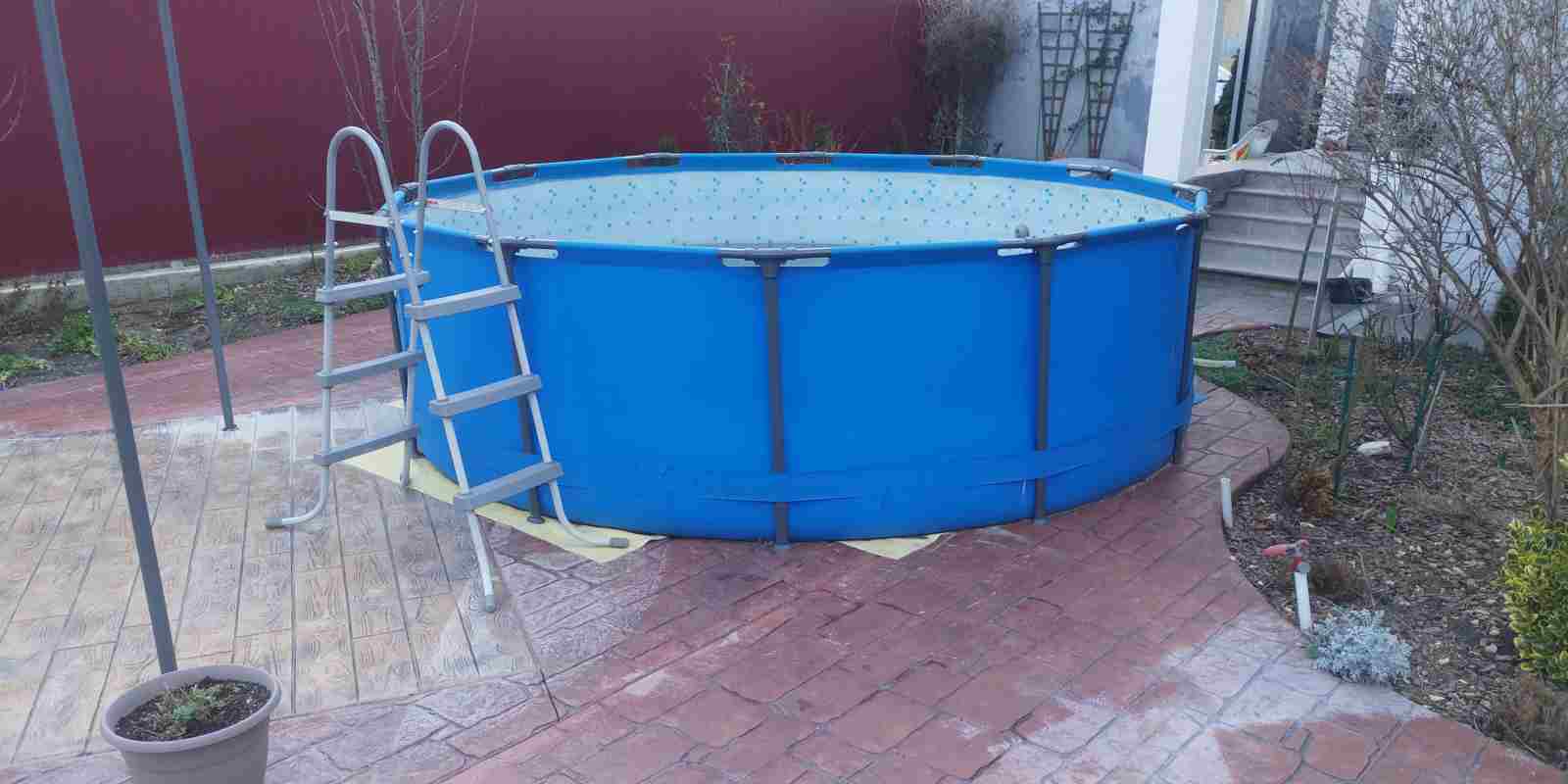

The costs you’ll find online for above-ground pool removal vary so much because most published figures price the pool by itself. The deck, the sand base, and the stairs are left out, and those pieces often take up more space on a truck than the wall alone does. Once every element is counted, the estimates with wildly different prices start to make sense.
Why Estimates Vary So Widely
A quote for the pool itself leaves the deck, the ladder platform, and the base sitting there unaccounted for. That is why a figure covering the full site looks more expensive on paper, even when both are for the same yard.
Total debris volume has a major effect on the price. A 15-foot pool produces a fraction of the material a 30-foot pool does, so it takes up much less truck space.
A flat rate factors in the crew’s time, fuel, disposal fees, donation drop-offs, and insurance. A crew sets that number after measuring the actual pile.
The Full Scope of a Pool Teardown
The teardown is completed in three stages: draining, cutting down, and clearing the base.
Rules on draining vary by jurisdiction. Chlorinated water cannot go straight into a storm drain since they carry runoff to local streams and rivers without treating it at all.
D.C.’s Department of Energy and Environment requires the chlorine to be removed. Then, the water has to go into the sanitary sewer system. A pool that drains into a park or other public space is considered a penalty under D.C. law that comes with a $1,000 maximum fine for a first offense.
Fairfax County’s discharge guidance treats a storm drain as the fallback option once the water is dechlorinated. Chlorine needs seven to 10 days to break down on its own, or a dechlorinating agent can speed that up, and the water has to test below 0.1 mg/L before it can be released.
Maryland’s Montgomery County skips the permit requirement for a residential pool serving fewer than four homes, though its 0.1 ppm chlorine cap for streams still applies.
Because the specifics for pool water draining differ from one jurisdiction to the next, make sure the crew you hire is aware of your specific community’s regulations.
Cutting down can start once the water is gone. Crews cut the steel wall into sections small enough to carry, pull and fold the liner, then break apart any attached deck, ladder, or stairs into pieces that fit on the truck.

Clearing the base is usually the heaviest lift of the job. Sand or gravel that has spent years under the pool does not come out easily. It has to be dug out by hand, bucket by bucket, and can be very heavy.
Most low estimates skip this last stage entirely, which can result in a low estimate that isn’t realistic.
What It Costs by Scenario
Truck space is what actually affects the price, so each individual situation is assessed based on what comes out and how much room it takes up. Pool deck removal cost folds into the total whenever a deck is attached, since the lumber and railings load out alongside everything else.
| Setup | What Comes Out | Truck Space Needed |
| Small pool, no deck | Wall, liner, frame, and pump | About a half load |
| Standard pool with sand base | Everything above, plus tons of base material | Half to three-quarter load |
| Pool with attached deck | Pool components, plus lumber, railings, and stairs | Full load or more |
| Pool, deck, and concrete pad | Full teardown, including hard fill | More than one load |
A concrete pad changes the plan more than any other single feature, because hard fill is dense and fills truck space fast. Since the flat rate is built around volume, it only reflects reality once the deck and the base are counted alongside the pool itself.
What You Can Realistically Do Yourself
Draining the pool and pulling the liner are manageable for most homeowners with a submersible pump and enough patience. Timing matters more than effort here, since Fairfax County’s seven-to-10-day dechlorination window means the project has to start well before the weekend set aside for demolition.
Disassembly can happen quickly. Hauling is where the job can stall, because curbside collection will not take a pool wall, a folded liner, deck lumber, or loose fill.
Sectioned steel takes up a lot of space and a sand base alone can mean several trips to a disposal site that accepts construction debris. Residential junk removal crews handle hauling as routine work, since loading a full truck of bulky material is what a crew does every day.
Where the Materials End Up

The steel wall, frame, and pump go to recycling. Vinyl liners and treated deck lumber go to disposal.
Burning treated lumber releases preservative chemicals into smoke, and grinding the boards into mulch spreads them through a garden bed instead. The Environmental Protection Agency’s wood disposal guidance points owners to state and local waste programs for the specific rules in their area, since the details vary by location.
Every load moves through Donate-Recycle-Dispose, our removal process, so the landfill only gets what can’t be moved elsewhere. Anything still usable, such as a ladder in good shape or hardware that has held up, may be eligible for donation before the rest moves on to recycling or disposal.
Get a Flat Above-Ground Pool Removal Cost That Covers the Deck
Homeowners in D.C., Northern Virginia, and Maryland can ask 123JUNK for a flat price that accounts for the deck, the base, and any concrete pad from the start. Schedule an appointment with the crew, or contact our team about what is attached to the pool, and we’ll set that number before the truck is loaded.
